Digital Marketing vs Social Media Marketing: What Is the Real Difference? ( 2026 Guide)
Introduction
If you have ever sat in a meeting in Islamabad or scrolled through a business group on WhatsApp in Rawalpindi and heard someone say [bas social media kar lo, digital marketing ho jaegi] then this guide is for you. That one sentence has cost Pakistani businesses millions of rupees in misdirected budget, wasted time and missed opportunities. Social media marketing and digital marketing are not the same thing. Treating them as synonyms is one of the most common and most expensive mistakes that small and medium businesses across Pakistan make today. This guide explains exactly what the difference is between digital marketing and social media marketing, which one your business actually needs and how Pakistani businesses from a biryani shop in Rawalpindi to a clothing brand in Lahore to a real estate firm in Bahria Town can use both strategically to grow in 2026.
Why This Difference Matters More In Pakistan
Before we define the terms, understand the context. Pakistan’s digital marketing landscape in 2026 is unique and the difference between digital marketing and social media marketing is especially consequential here.
Pakistan Digital Stats You Need to Know
| Metric | Pakistan 2026 Data | What It Means for Your Business |
| Internet Users | 133 million+ | Massive addressable audience online but competition is intensifying |
| Social Media Users | 71 million+ active users | Facebook, TikTok, Instagram, YouTube dominate |
| Facebook Penetration | Pakistan is among the top 10 Facebook using countries globally | Facebook remains the #1 social platform for Pakistani businesses |
| TikTok | Pakistan has one of the highest TikTok engagement rates in Asia | Short form video is not optional for Pakistani consumer brands in 2026 |
| Google Searches (Pakistan) | Billions of queries per month for ‘near me’ searches | SEO is an underexploited channel most Pakistani businesses ignore |
| E-commerce Growth | Pakistan’s ecommerce market crossed $6 billion in 2025 | Daraz, social commerce and direct to website selling are all growing |
| Mobile Internet | 95%+ of Pakistani internet users access via smartphone | All digital marketing must be mobile first, desktop only designs fail |
| WhatsApp Penetration | One of the highest globally, nearly universal among smartphone users | WhatsApp marketing is a legitimate channel unique to Pakistani market |
The core problem
Most Pakistani businesses put 90% of their digital marketing budget into social media, usually Facebook boosting and Instagram posting and wonder why they are not growing consistently. The reason is that social media alone cannot replace search visibility, email relationships or a conversion optimized website. You are paying to reach people who were not looking for you, while your competitors are getting found for free by people actively searching for exactly what you sell.
What Is Digital Marketing?
Digital marketing is the full umbrella strategy of promoting a business, product or service through any digital channel. It is not one tactic. it is an entire system of channels, each serving a different purpose in the customer’s journey from first hearing about you to finally buying from you. Think of digital marketing as your entire online business infrastructure. It is everything that happens between a potential customer and your business in the digital world.
Digital Marketing Channels
| Channel | What It Does | Media Type | Time to ROI |
| SEO | Ranks your website on Google for targeted keywords which drives free, high intent traffic | Owned + Earned | 3–12 months |
| PPC (Google Ads) | Places paid ads on search results for immediate visibility and traffic for specific queries | Paid | Days to weeks |
| Email Marketing | Nurtures leads and customers with targeted messaging directly in their inbox | Owned | Immediate |
| Content Marketing | Creates valuable blog posts, guides and videos that attract, educate and convert your audience | Owned + Earned | 3–9 months |
| Social Media Marketing | Builds brand presence, community and engagement across social platforms | Owned + Paid + Earned | Weeks to months |
| Display Advertising | Shows visual banner ads across websites and apps to build brand awareness and retarget visitors | Paid | Immediate |
| Affiliate Marketing | Partners with publishers and creators who promote your product for a commission | Earned | Weeks to months |
| Video Marketing | Engages audiences via YouTube, YouTube Shorts and streaming platforms with branded content | Owned + Paid | Varies |
| Marketing Automation | Automates email sequences, ad retargeting and lead nurturing workflows based on user behavior | Owned + Paid | Weeks |
What is Social Media Marketing?
Social media marketing (SMM) is the practice of using social media platforms to build brand awareness, engage your audience, drive traffic and generate leads or sales. It is one powerful channel within the larger digital marketing ecosystem. In Pakistan’s context, social media marketing is often what people picture when they hear the word ‘digital marketing’ because Pakistanis are deeply social in their online behavior. This makes social media marketing particularly impactful here. But it also means the channel is increasingly crowded and competitive.
What Is Included In Social Media Marketing?
- Paid social advertising: Running targeted ad campaigns on Meta (Facebook + Instagram Advertising), TikTok Ads, LinkedIn Ads, Pinterest Ads and Snapchat Ads.
- Influencer and creator marketing: Partnering with content creators whose audiences align with your brand from macro influencers to micro and nano creators.
- Social listening and monitoring: Tracking brand mentions, competitor activity and industry conversations to inform content and strategy.
- User generated content (UGC) campaigns: Encouraging customers to create and share content featuring your brand, the highest trust form of social proof
- Short form video strategy: In 2026, Reels, TikTok videos and YouTube Shorts dominate organic reach across every platform, video is no longer optional
- Social commerce: Selling directly through social platforms via Instagram Shop, TikTok Shop, and Facebook Marketplace, the boundary between social and e-commerce is dissolving
- Organic content creation: Publishing posts, carousels, reels, stories, live video and threads on platforms like Instagram, Facebook, TikTok, LinkedIn, X (Twitter), YouTube and Pinterest
- Community Management: Responding to comments and DMs, managing reviews, running polls and building genuine audience relationships
A Complete Breakdown Between Digital Marketing and Social Media Marketing
This is the section most articles get wrong. They give you a simple table and move on. The real difference between these two disciplines runs deeper than scope, it affects how you set goals, how you measure success, how you allocate budget and how you hire or work with an agency.
Scope (The Clearest Distinction)
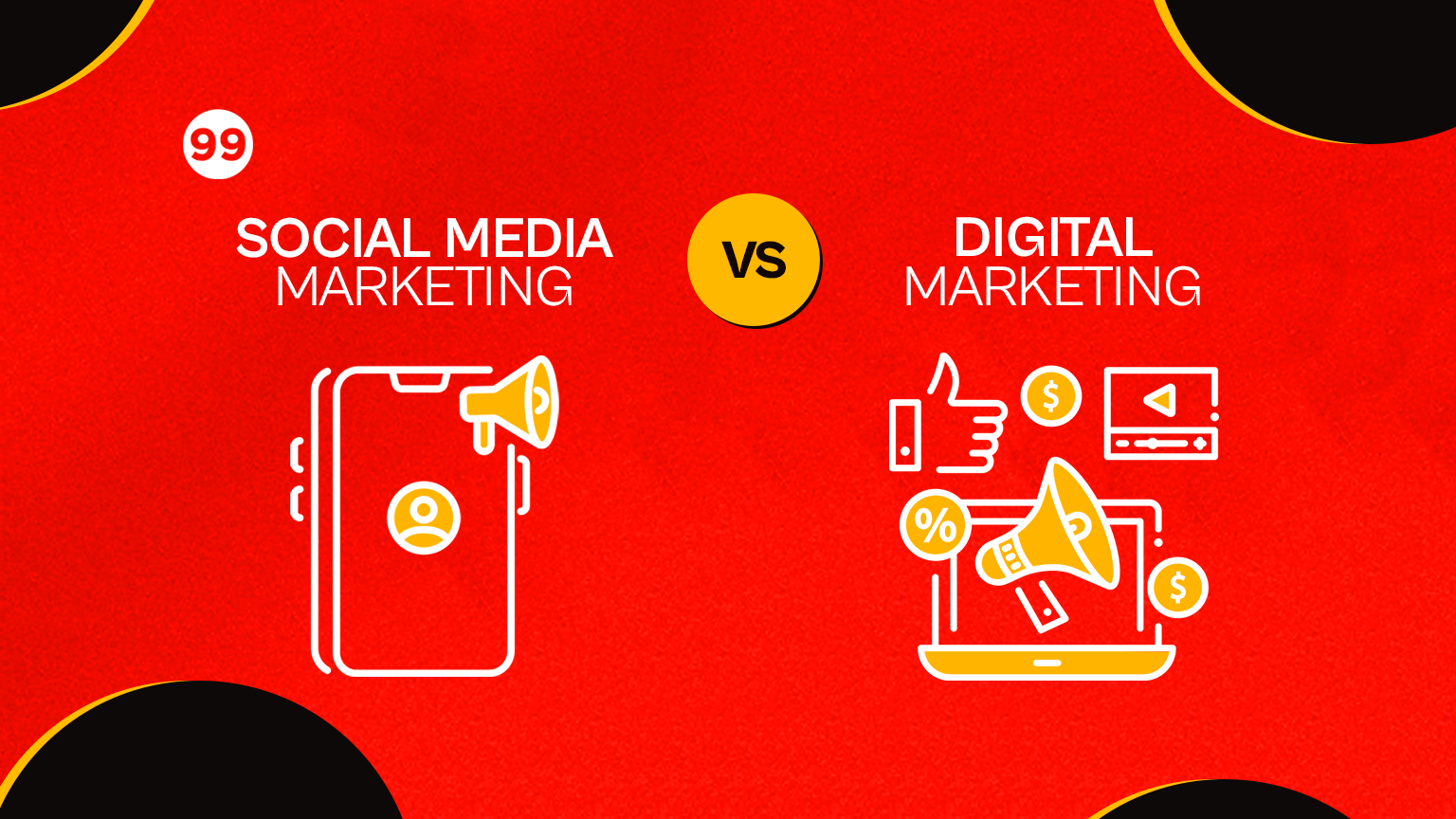
Digital Marketing covers every online channel like search engines, email, websites, display networks, social platforms, video, affiliate partnerships and more. It is channel agnostic and it uses whatever works to reach the right person at the right moment. Social Media Marketing covers only social platforms. It is channel specific, everything happens within the walled gardens of Meta, TikTok, LinkedIn, X, Pinterest and Snapchat.
The logical relationship: Every social media marketing effort is a subset of digital marketing. But digital marketing goes far beyond social media and most of the highest ROI activities (SEO, email marketing, content) happen completely outside of social platforms.
Purpose and Goals
| Goal Type | Digital Marketing | Social Media Marketing |
| Primary Focus | Full customer journey → awareness → consideration → conversion → retention | Top of funnel → awareness, engagement and brand affinity |
| Traffic Source | Search engines, email, referrals, display, direct and social | Social platform feeds and discovery algorithms only |
| Lead Generation | High → SEO, PPC and email are among the top lead gen channels globally | Moderate → requires strong conversion strategy beyond the platform |
| Revenue Impact | Direct → PPC, email and SEO campaigns are directly tied to revenue attribution | Often indirect → social builds the awareness that later converts elsewhere |
| Audience Ownership | Yes → email lists and SEO traffic are owned assets you control completely | No → your followers belong to the platform, not to you |
| Brand Building | Long term → SEO authority, content reputation and email relationships compound over time | Rapid → social media is the fastest tool for mass brand visibility |
| Customer Retention | High → email marketing is the most effective retention channel with proven CLV impact | Moderate → social keeps existing customers engaged but rarely drives repeat purchase alone |
Cost Structure and Budget Allocation
| Cost Dimension | Digital Marketing | Social Media Marketing |
| Organic Investment | SEO → high upfront content + technical investment → long term free traffic | Organic posting → content creation time and tools → no platform fees |
| Paid Investment | Google Ads PPC → costs scale with competition → high purchase intent | Paid social → pay per impression or click → lower intent but massive reach |
| Asset Value | SEO rankings and email lists are long term owned assets that appreciate over time | Follower counts are borrowed, platform algorithm changes can zero out your reach overnight |
| Scalability | SEO scales with content, PPC scales with budget and email scales with list size | Organic reach is algorithmically capped and paid social scales with budget only |
| Best ROI Channel Globally | Email marketing → average ROI of $36-42 for every $1 spent (Litmus, 2024) | Influencer marketing with micro creators → 3-5x higher engagement vs macro |
Critical insight: Social media metrics are often visible and satisfying, a viral post with 50,000 views looks impressive. But views do not pay invoices. The discipline of digital marketing forces you to connect every activity to revenue impact. Businesses that only track social metrics often discover they have built an audience without building a business.
Which Strategy Does Your Business Actually Need?
This is the most practical question and it deserves a more rigorous answer than ‘it depends.’ Here is a framework for making the right decision based on your specific situation.
Start With Your Primary Business Goal
| If Your Primary Goal Is… | Prioritize This | Secondary Channel |
| Getting found on Google by people searching for your service | SEO + Content Marketing (Digital Marketing) | Social Media for trust signals |
| Building brand awareness and community quickly | Social Media Marketing | Content marketing for depth |
| Generating leads with a measurable cost per lead | PPC (Google Ads) + Email Marketing | Social ads for retargeting |
| Building a loyal customer base that buys repeatedly | Email Marketing + Content Marketing | Social media for engagement |
| Growing a product based e-commerce business | SEO + Social Commerce + Email | PPC for high intent keywords |
| Establishing B2B credibility and thought leadership | LinkedIn + Content Marketing + SEO | Email for nurturing |
| Fast visibility for a new brand or product launch | Paid Social Ads + Influencer Marketing | PPC for search intent |
| Long term sustainable growth with compounding ROI | SEO + Email + Content Marketing | Social for amplification |
Consider Your Business Stage
Early stage (0–12 months): Social media marketing is typically the right starting point. Social Media is low cost to begin, builds immediate visibility and generates social proof through reviews and engagement. However, begin building an email list from day one, that list will be your most valuable asset in years two and three.
Growth stage (1–3 years): This is when SEO becomes critical. You now have domain authority to build on, testimonials to leverage and a content strategy to implement. PPC should be tested to identify the highest converting keywords. Email marketing should be actively segmented and automated.
Established stage (3+ years): The focus shifts to optimization, retention and compounding. SEO should be producing consistent organic traffic. Email should be your top revenue channel. Social media should be maintained for brand presence and community but it is rarely the highest ROI investment for established businesses.
How Both Disciplines Work Together
The businesses generating the strongest results in 2026 are not choosing between digital marketing and social media marketing. They are using social media to amplify everything their digital marketing produces and using their digital marketing infrastructure to convert the attention that social media generates.
- Content is written and SEO optimized for Google, targeting high intent search queries in your industry
- The same content is repurposed into social media formats like short videos, quote graphics, carousel posts and story summaries distributed across platforms
- Social engagement drives traffic back to the website where visitors find email opt-ins, lead magnets and conversion optimized landing pages
- Email captures the visitor and nurtures them with automated sequences that deliver value and move them toward a purchase decision
- Paid retargeting reconnects with visitors who did not convert using Google display and social ads to stay top of mind during the consideration phase
- Conversions feed back into content, customer testimonials become social proof content, common objections become blog topics and purchase patterns reveal new keyword opportunities.
How 99 Marketing Studio Approaches Both Disciplines
At 99 Marketing Studio based in Rawalpindi and serving businesses across Rawalpindi and Islamabad, we have seen the consequences of this confusion firsthand. Businesses that invested years in social media without building any SEO or email foundation. Brands with 20,000 followers that generated almost no consistent revenue. And the reverse, businesses with strong Google rankings and email lists but no social presence, missing enormous trust building opportunities. Our approach is integrated by design. We do not build social presence in isolation from search strategy or run ads without a conversion optimized destination. Every element of what we do is built to work together because that is the only approach that produces compounding, sustainable results. let us build a strategy that makes both work together to grow your business. Contact 99 Marketing Studio for a Free Strategy Consultation